The Fields in Trust benchmarks
Six acres per thousand people, play space typologies and local standards: where the famous benchmarks came from.
The Common Ground editorial deskPublished 5 min read
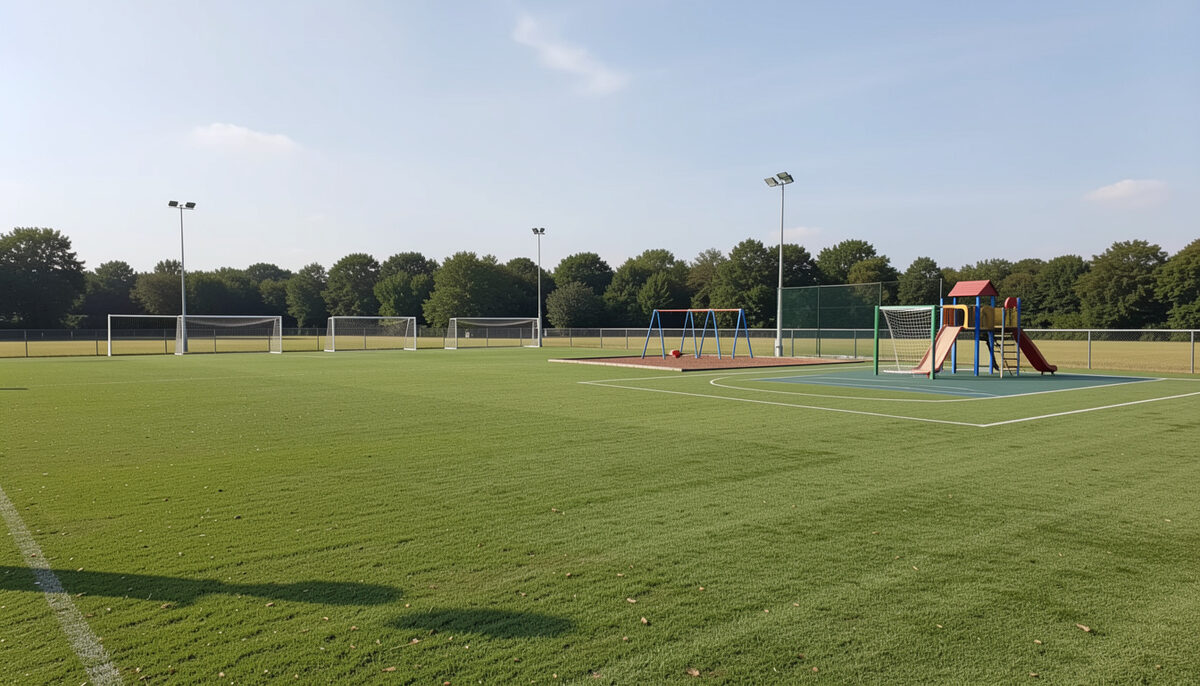
Fields in Trust, formerly known as the National Playing Fields Association (NPFA), has long served as a point of reference for open space planning in Britain. Among its most influential contributions are benchmark standards for outdoor space, including the well-known "six-acre standard" and a typology of dedicated play spaces for children. For local authorities seeking a defensible basis for local plan policies and open space assessments, these benchmarks have provided a starting point rather than a fixed rule.
This article explains the benchmark standards, the LAP/LEAP/NEAP play space typology, and how councils have adapted national guidance into locally determined provision standards. The consultancy behind this website, Ashley Godfrey Associates, worked with Fields in Trust on the development of the national benchmarks for different types of play space, an involvement recorded in its practice history.
The six-acre standard
The six-acre standard is the best known of the Fields in Trust benchmarks. In its simplest form, it suggests that 6 acres of outdoor playing space should be provided for every 1,000 people, a figure that translates into metric terms as roughly 2.4 hectares per 1,000 population. The standard is normally broken down so that a substantial portion is allocated to organised sport, such as pitches and courts, while the remainder is for children's playing space, including equipped playgrounds and informal play areas.
The standard's origins lie with the National Playing Fields Association, which for much of the twentieth century campaigned for adequate land for play and recreation. The NPFA's guidance was widely cited in structure plans and local plans, and later carried forward into government planning guidance. It is important to understand what the standard is not: it is not a statutory requirement. It has always functioned as a benchmark, a yardstick against which actual provision could be measured and local decisions justified.
The play space typology: LAP, LEAP and NEAP
Alongside the quantity benchmark, Fields in Trust developed a typology that distinguishes between types of children's play space according to their size, the equipment they contain, the age groups they serve and the distance they are expected to be from the homes they serve. The three principal categories are:
- LAP (Local Area for Play): a small area of open space close to home, intended primarily for young children and low-key, informal play.
- LEAP (Local Equipped Area for Play): a larger equipped play area serving a wider catchment, with several items of play equipment and a broader age range in mind.
- NEAP (Neighbourhood Equipped Area for Play): a substantial play space with a wider range of equipment and facilities, serving a neighbourhood catchment and accommodating older children and young people as well as families.
Each type carries guidance on indicative size, activity zone, buffer distances from housing, and walking distance from the population served. The typology gives planners and play officers a shared vocabulary: rather than describing every playground generically, an authority can audit its stock against defined categories and identify gaps in provision by type. It also links play space to accessibility analysis, since a district may have adequate provision in total while leaving particular neighbourhoods beyond the walking distance of any equipped site, a problem that catchment mapping is designed to expose.
From national benchmark to local standard
Government planning policy, from PPG17 through to the National Planning Policy Framework, has consistently encouraged local authorities to set their own open space standards, based on local assessment of need and existing provision rather than mechanically adopting national figures. This is where the Fields in Trust benchmarks have proved most useful. They provide a reliable point of reference: an authority starting from the six-acre standard and the LAP/LEAP/NEAP typology can depart from them where local evidence justifies it, while still anchoring its standards in a recognised national framework.
In practice, the typical adaptation process runs as follows. The authority first audits all existing open space and play provision, classifying each site by type and assessing its quality. It then consults residents, including children and young people, to establish how spaces are used and what is lacking. Against this evidence, quantities, accessibility thresholds and quality expectations are set locally. Some authorities retain the national figures; others adjust them for density, demographics or established local patterns of use. A detailed account of how such assessments have been carried out in practice is given in the note on a PPG17 open space assessment and in the wider discussion of how children's play provision is assessed.
Why the benchmarks endure
Benchmarks survive in planning practice because they answer a question that raw evidence cannot: compared with what? A statement that a district has 1.8 hectares of playing space per 1,000 residents means little without a reference point. The Fields in Trust standards supply that reference point, and the play typology adds a second dimension by distinguishing between kinds of provision, so that a surplus of informal space is not mistaken for adequate equipped play provision.
The standards are also robust in negotiation. When a planning authority seeks open space contributions from a developer, or defends an allocation of land for play against competing uses, a standard traceable to a recognised national benchmark carries more weight than a locally invented figure. The NPPF's requirement that standards be based on evidence, as discussed in the transition from PPG17 to the NPPF, makes the combination of national benchmark and local audit all the more important.
A living framework
Fields in Trust has revisited its guidance over the years, updating the guidance for England and Wales to reflect changes in planning policy and in understanding of children's play. The organisation continues to publish its benchmark standards and to advocate for the protection of recreational land; its current guidance is available at fieldsintrust.org. For authorities, the lesson of the benchmarks' long life is straightforward: national figures are a floor for thinking, not a ceiling. The enduring craft of open space planning lies in the local audit, the consultation and the catchment analysis that turn a benchmark into a standard a community can actually rely on.