How children's play provision is assessed
Play England indicators, Fields in Trust benchmarks and play strategies: what good local play provision looked like.
The Common Ground editorial deskPublished 6 min read
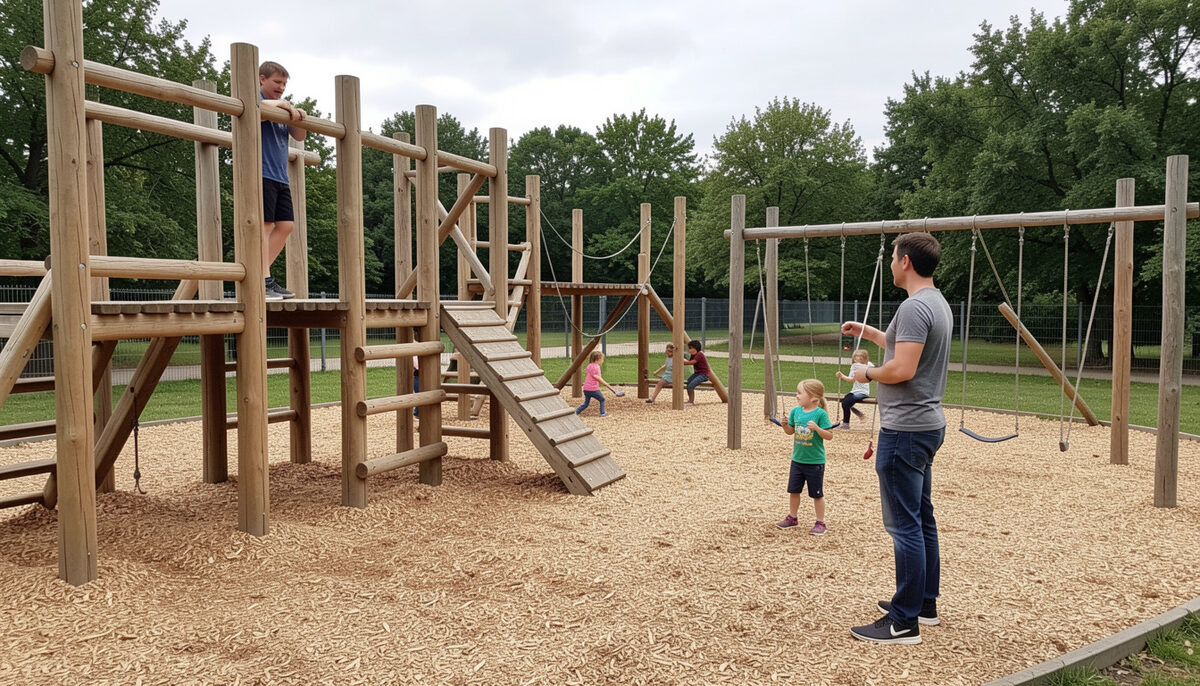
How do councils know whether children's play provision is any good? The question sounds simple, but answering it has occupied planners, play organisations and national bodies for decades. Judging a playground, a staffed adventure play project or an informal patch of grass requires tools that are consistent enough to compare one authority with another, yet flexible enough to reflect what children themselves say they want. A body of archived sector work, developed during the 2000s and 2010s, shows how the play field built up its assessment apparatus piece by piece.
This article surveys that archived work: performance indicators developed with Play England and the then Department for Culture, Media and Sport (DCMS), guidance on play strategies, a quality assessment tool, national benchmarks from Fields in Trust, and locally developed questionnaires such as the one piloted in Bristol. Together they trace a shift from counting swings to asking harder questions about inclusion, accessibility and quality.
Performance indicators for children's play
The most significant step towards systematic assessment came with the development of Performance Indicators for Children's Play, a project on which the planning and leisure consultancy Ashley Godfrey Associates worked alongside Play England and DCMS. The purpose was stated plainly: to provide a robust assessment of the extent to which local authorities are providing children and young people with good, inclusive and accessible free local play spaces, services and facilities.
Each element of that formulation carried weight. "Free" distinguished open-access play from charged provision. "Inclusive" pressed authorities on whether disabled children and those from minority communities could genuinely use the spaces on offer. "Accessible" asked about distance, transport and the physical design of sites. The indicators gave councils a common vocabulary at a time when play strategies were becoming an expectation rather than an optional extra, and when capital funding programmes required evidence that money was reaching children who needed it.
Performance indicators of this kind belong to a wider family of measurement work in local authority leisure services. Similar logic underpins performance management in practice across parks, sport and cultural services, where the challenge is always the same: turning a qualitative judgement about quality into something that can be tracked over time.
Planning for Play and the strategy guidance
Indicators only make sense inside a strategy. The companion piece was Planning for Play, the Play England guidance on preparing play strategies, prepared with the help of an advisory group on which Ashley Godfrey served. The guidance set out how authorities should move from an evidence base, through audits of existing provision and consultation with children, to adopted policies and locally determined standards.
The advisory group model reflected the collaborative character of the play sector at the time: national bodies, consultants, local authority officers and play workers each contributing expertise. Strategy-making of this kind sits within the broader tradition of open space planning, and readers interested in that lineage can follow the story of how assessment practice developed from the old PPG17 regime to the modern planning policy framework.
A quality assessment tool and the Bristol questionnaire
Strategy documents can be strong on maps and weak on the experience of a child standing in a playground. Two pieces of archived work addressed that gap directly. The first was the Quality Assessment Tool for play, developed with and supported by Haki Kapasi. The tool gave practitioners a structured way of scoring the quality of play spaces and services, looking beyond equipment condition to the qualities that matter for play itself: variety, challenge, and the scope for children to shape their own activities.
The second was a play questionnaire developed with Bristol City Council for completion by children themselves. Asking children directly, in language and formats they can engage with, is a distinctive discipline. It contrasts with the postal and online surveys that dominate adult consultation, and it connects to the wider craft of surveys and audits of local provision, where rigour in design and analysis determines whether the results mean anything. Children's responses are not simply smaller versions of adult survey data; they require careful question design, appropriate settings and honest interpretation.
Both tools shared a premise: that quality judgements should be anchored in the user's perspective. Consultation exercises with children and young people, undertaken to support play strategies across a number of authorities, reinforced the same point, as did detailed audits of existing provision used to identify priorities for improvement.
Fields in Trust and national benchmarks
The third strand of assessment work addressed the question of comparison. Ashley Godfrey Associates worked with Fields in Trust, formerly the National Playing Fields Association (NPFA), on the development of national benchmarks for different types of play space. The benchmarks were intended to give local authorities a reliable point of reference when developing their own locally-determined provision standards.
The emphasis on "locally-determined" matters. The benchmarks were never meant to be imposed as national minimums; they provided a yardstick against which an authority could calibrate standards derived from its own audits and consultation. The approach is described further in the Fields in Trust benchmarks, which set out how the different categories of play space were treated. Benchmarking of this kind runs in parallel with the quantitative traditions of playing pitch work, where the playing pitch strategy has long offered a model of demand-based assessment that play provision has adapted rather than copied.
What the archived work still teaches
Looking across these projects, several consistent lessons emerge.
- Assessment must serve strategy, not replace it. Indicators, tools and benchmarks were all developed to feed into play strategies and adopted standards, not to stand as ends in themselves.
- Children's own voices are evidence. The Bristol questionnaire and focused consultation exercises treated children as legitimate sources of data about the spaces built for them.
- Quality is more than quantity. The Quality Assessment Tool and the performance indicators both pushed against simple hectare-per-thousand-population arithmetic in favour of judgements about inclusivity, accessibility and play value.
- National reference points and local standards can coexist. The Fields in Trust benchmarks were designed to inform local standards, respecting variation between places while giving authorities a defensible point of comparison.
The infrastructure of play assessment that emerged from this period, much of it coordinated through Play England and its partner bodies, remains a reference point for authorities reviewing provision today. The tools have evolved, but the underlying questions have not: is the space free, is it inclusive, is it accessible, and would a child actually want to play there?
For those approaching play provision from the open space planning side, the same assessment principles appear in related fields, from parks and open space planning to the mapping of catchments and access. Play assessment is, in the end, one branch of a larger craft: finding out what exists, asking people what they need, and setting standards that stand up to scrutiny.